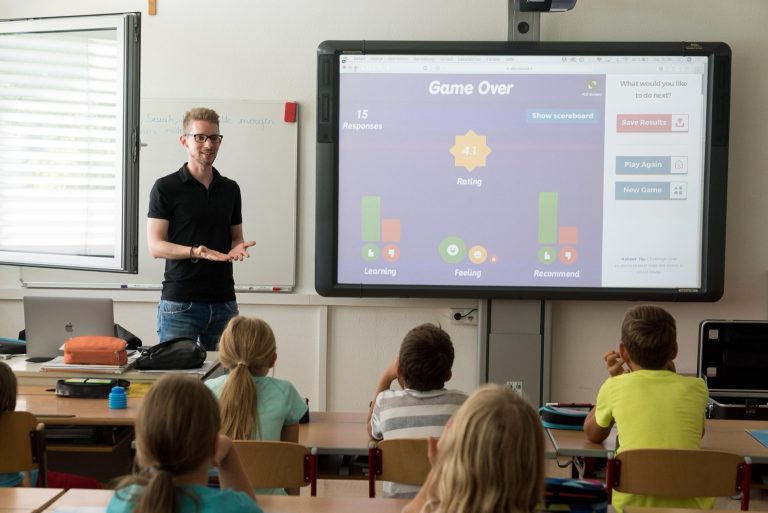
Almost every school has seen this scene: in the procurement meeting, the product demo draws excitement and every department signs off; deployment goes smoothly as well. Then a semester passes, and the activity data in the backend is far thinner than the investment — most accounts have logged in only on training day.
This is not one school’s story; it is the most common gap in education’s adoption of AI. We want to state a clear judgment: go-live rate is not adoption rate. Finishing deployment is “going live”; teachers using it in daily teaching is “landing.” Most schools get stuck on the latter.
Between “live” and “landed” lies an adoption gap
Going live is IT’s milestone; landing is the academic affairs office’s daily routine. The first asks whether deployment is complete; the second asks whether teachers use AI in the things that genuinely happen every day — lesson prep, teaching-research meetings, evaluation. Conflating the two leads to misdiagnosis. Three misdiagnoses are common:
- Treating it as a training problem: training can solve “knowing how,” but not “wanting to.” The reason teachers don’t use a tool after the demo was never that they couldn’t find the button;
- Treating it as a willingness problem: blaming “teachers don’t like new tools” on conservative attitudes is the laziest and most wrong conclusion — teachers don’t resist tools; they resist anything that adds net burden;
- Treating it as a technology problem: swap in a more advanced tool, and the teacher’s desktop simply gains another icon. The number of tools has nothing to do with adoption.
Teachers aren’t rejecting AI — they’re rejecting “one more step”
Teachers are among the most time-scarce professionals, and among the most aware of what their time is worth. Any new tool that adds more steps than it removes is destined to be shelved — that is not an attitude problem, it is time economics. There is only one prerequisite for teachers to use it: it must genuinely make some daily task faster and lighter.
More subtle are trust and incentives. If the AI’s suggestion is wrong, who is accountable? If using AI counts toward no form of recognized work, while its mistakes are the teacher’s to answer for, the rational choice is to wait and see. Schools owe teachers two things: understandable reasoning (why the AI judged this way) and preserved discretion (the final call stays with the teacher). With those two in place, trust becomes possible.
Embed AI into the workflow, not onto the desktop
The way across the gap is not more training; it is putting AI into the workflows teachers already walk. Four points:
- Start from one high-frequency, must-happen process: lesson-prep meetings, homework review, lesson observation — pick one segment that happens every day and let AI steadily save time inside it. We discussed AI classroom evaluation as such a starting point in an earlier article (see The AI Pilot Era Is Over: It’s Time for Education to Move Beyond Experimentation);
- Let AI speak in the school’s own language: general models have capability, but teachers’ trust is built on “it understands our school” — evaluation rubrics, teaching norms, and data context must all come in. That is exactly the problem Education Intelligence solves (see Education Intelligence and why generic AI falls short);
- Leave review with the teachers: AI output goes into the teaching-research meeting for review, and deviations are recorded and fed back into rubrics and rules — with humans in the loop, the tool gets better the more it is used;
- Measure the right thing: track “the share of teachers who genuinely save time with it each week,” not logins. What adoption measures is not logins but time saved.
A post-launch checklist for decision-makers
- Push one scenario per semester; do not roll out everything at once;
- Start with seed teachers (for example, teaching-research group leaders) instead of all-staff training;
- Fix a standing AI-review slot in the teaching-research meeting, so usage becomes part of the process rather than an extra task;
- Collect every correction from teachers and feed it back into rubrics and rules;
- Close the semester by reviewing “time saved,” not login reports.
In our previous article we argued that the pilot era for large language models is over, and that the risk of waiting now outweighs the cost of acting (see The AI Pilot Era Is Over: It’s Time for Education to Move Beyond Experimentation). This piece adds the second half of that sentence: the mark of success is not the procurement list or the launch announcement — it is an ordinary workday when a teacher says, unprompted, “This saved me an hour.”
If you are designing the adoption path for AI in your school, or want to talk about how a specific scenario could be embedded, we would love to talk — contact us.